
One Email. All Gone. The Real Risk of Single-Provider AI Dependency
A company's 60+ Claude accounts were shut down overnight with no explanation. The only appeal process: a Google Form. This happened yesterday. It can happen to you.

Yesterday, a post from Pato Molina went viral. 1.1 million views and counting.
His company's 60+ Claude accounts were terminated. Overnight. No warning. No explanation. Just an email from Anthropic's Safeguards Team stating that automated systems had detected "signals" associated with policy violations.
The only way to appeal: fill out a Google Form.
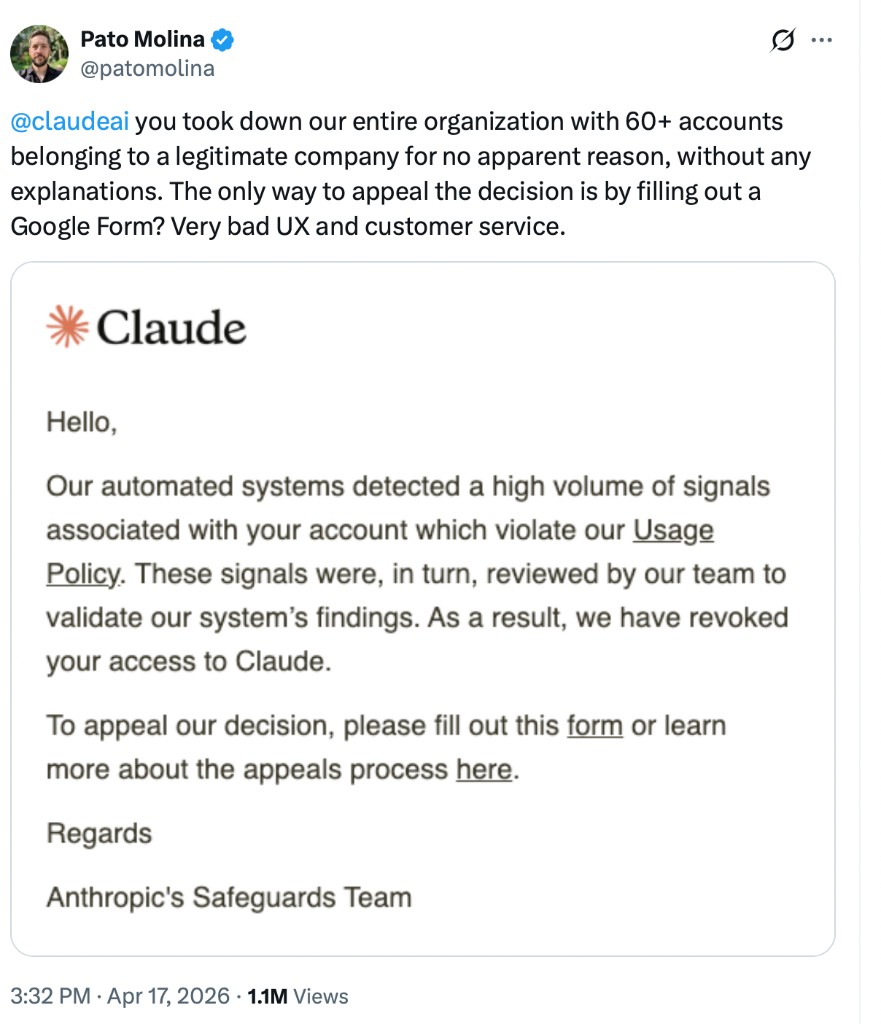
That's it. That's your leverage when your entire organization is a Vendor Hostage.
This Is What Lock-In Actually Looks Like
Most conversations about AI vendor lock-in focus on migration costs. Engineering time. Data pipeline rewiring. Prompt reconstruction.
Those are real problems. But they assume you have time to migrate.
This is the scenario nobody plans for: you wake up and your AI is gone.
No degraded performance. No "please upgrade your plan." No 30-day notice. Your team opens their laptops on a Tuesday morning, and nothing works.
Sixty people. Legitimate company. Legitimate work. Gone before the first coffee.
And the mechanism that took them down? Automated systems. Reviewed by a team. No specifics. No context. No recourse except a form.
This Is Not Anthropic Being Uniquely Bad
Let's be direct: this isn't a criticism of Anthropic. Every Titan has this risk built in.
Every major AI provider:
- Has automated detection systems that can flag accounts incorrectly
- Has usage policies that can change without notice
- Has a pricing structure that can shift based on investor pressure
- Has a business strategy that can pivot overnight
Remember the OpenAI board crisis of 2023? The company running your AI can change leadership, strategy, and terms of service while you sleep.
Google has discontinued products that millions depended on. Microsoft has pivoted entire platforms. The Titans have committed over $1 trillion to win a war for AI supremacy. Your account continuity is not their primary concern.
The Three Ways a Single Provider Takes You Down
The Ban. Automated systems misfire. Policy interpretations change. You build something innovative that gets flagged as something else. One overnight decision, and 60 people have no AI. That's what happened yesterday.
The Pivot. Pricing doubles. The capabilities your workflow depends on move to a higher tier. The feature you built around gets deprecated. You weren't banned. You were priced out. The result is the same.
The Outage. These are on the public record. Every major AI provider has had them. When your entire operation runs through one pipe, that pipe going down doesn't slow you down. It stops you cold.
Model-agnostic organizations experience all three as inconveniences. Single-provider organizations experience them as crises.
The Announcement Test: Ban Edition
Here's the version that keeps AI leaders up at night.
On Wednesday morning, Anthropic's automated system flags your organization.
With single-provider architecture:
- Your team opens their laptops
- Nothing works
- You find the email
- You fill out a Google Form
- You wait
- Your competitors haven't stopped
With model-agnostic architecture:
- Your team opens their laptops
- Your platform routes to another provider automatically
- You submit the appeal and haven't lost a day
- You've already moved on
Which organization do you want to be?
The Titans Are at War. Your Organization Doesn't Have to Be a Casualty.
Microsoft, Google, OpenAI, Anthropic, xAI. Five of the most powerful technology companies ever assembled, spending more than any previous technology race. They can't all win. Markets don't work that way.
When they pivot, stumble, or fight each other, the collateral damage lands on organizations that made concentrated bets.
The smartest organizations aren't betting on a winner. They're building infrastructure that doesn't need to.
Model-agnostic architecture means:
- Zero single point of failure. One provider goes down, another picks it up. Automatically.
- Zero negotiating weakness. You can walk away, and they know it.
- Zero migration drama. A new model releases on Tuesday. You're using it by Wednesday.
- Titan-Proof. Whatever happens in the war, you're not a casualty.
The winning bet is no bet.
The Window Is Closing
Every week your organization runs on a single provider is a week of exposure you can't close retroactively.
Pato Molina's company will probably get their accounts back. They'll explain they're legitimate. They'll wait for a human to review the Google Form. And they'll lose days while their competitors don't.
The next organization this happens to might not be as patient. Or as lucky.
Don't build your AI strategy on a foundation a Google Form can shake.
UniversalContext is built on model-agnostic architecture: access to every major AI provider, zero single-point-of-failure dependency, instant fallback when any Titan stumbles. No pitch. No pressure. Just a 30-minute look. Start the Conversation before your organization needs that Google Form.
Ready to Win Together?
See how UniversalContext can help your team find answers in seconds, not hours.
No pitch. No pressure. Just a 30-minute look at how this works.
See It In Action